

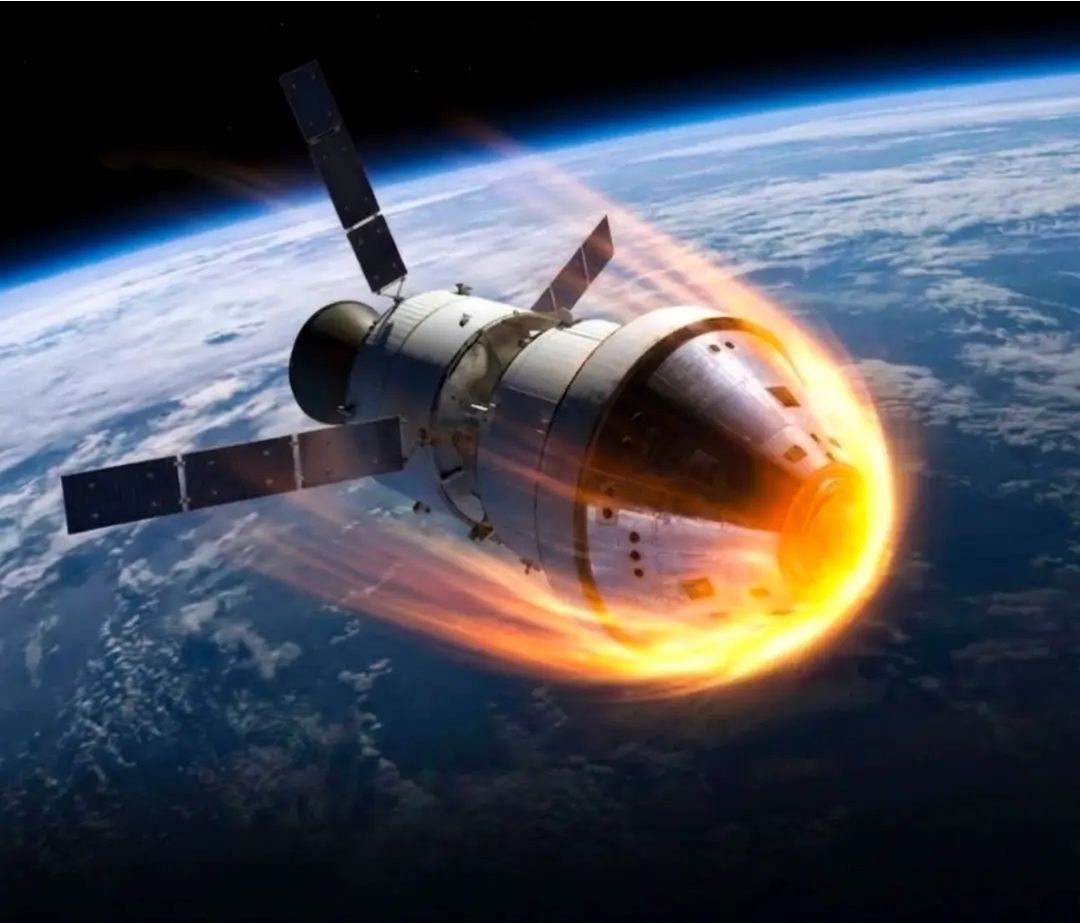
After traveling hundreds of thousands of kilometers through deep space, the crew of Artemis II is about to face the most dangerous part of their journey back to Earth.
The four astronauts, who have arleady broken the record as the human beings who have travelled farthest in space, are scheduled to arrive home, when their Capsule will splash down in the Pacific Ocean off the coast of San Diego, California, on Friday, April 10, 2026, at approximately 8:07 p.m. EDT (5:07 p.m. PDT / 00:07 GMT April 11/ 03:07 EAT April 11).
Live coverage of the reentry and landing will be available on NASA+ starting at 6:30 p.m. ED.
They will be recovered from the waters by The highly trained Navy army of the United States of America.
The Landing Phenomenon
When the Orion spacecraft hits Earth’s atmosphere, it will be moving at around 40,000 km/h (≈11 km/s).
What This Speed Means
A speed of 40,000 km/h is tremendously faster than a typical bullet, acting more as a hypersonic orbital or interplanetary velocity rather than a typical projectile speed.
At 40,000 km/h, a projectile is moving roughly 10 to 15 times faster than a typical rifle bullet.
The velocity is fast enough to cross all countries of the entire Earth in minutes. At that speed, the danger isn’t impact. It’s heat.

As Orion slams into the upper atmosphere, the air in front of it compresses violently, heating up to nearly 3,000°C. The spacecraft doesn’t “burn” — instead, a superheated plasma forms around it, turning the capsule into a blazing fireball.

For a few intense minutes, this plasma sheath will block all radio signals. The astronauts will be completely silen, and no contact will be possible with Earth.
This means, they will be without any communication or signal for those four minutes of horror.
Everything will, at this point, depend on the heat shield — a critical layer designed to slowly burn away (ablate), carrying heat with it and protecting the crew inside.
During Artemis I, engineers noticed that parts of Orion’s heat shield showed unexpected cracking and material loss. This wasn’t a failure, but it revealed that the ablation behaved differently than predicted — likely due to uneven heating and gas pressure buildup inside the material layers during reentry.
Since then, NASA has adjusted both the trajectory profile and heat shield design expectations to reduce those stresses for Artemis II.
But Even After Surviving The Inferno, One final Test Temains
At the right moment, a sequence of parachutes must deploy perfectly — first small drogues, then the massive main chutes.
If they fail, the capsule would hit the ocean at extreme speed.
As the fact remains that: space is unforgiving, the reentry is where everything; physics, engineering, and human lives — converge in just a few minutes.
But here’s the other truth.These systems have been tested, refined, and pushed to their limits. The risks are real — but they are understood, calculated, and prepared for.
In just four minutes, we’ll be reminded of something powerful: That returning from the edge of the Moon is just as heroic as reaching it—that the astronauts must comply perfectly with the time limit of the